
Mastering your time is one of the most critical parts of mastering your business. Once we spend all our money, we can go get more money. But once we spend all our time, it’s gone.
How you use your time in business is absolutely critical to whether you succeed or fail.
Let’s talk about where your time should be spent as a business owner and business leader.
You can think of your time target as a bullseye:
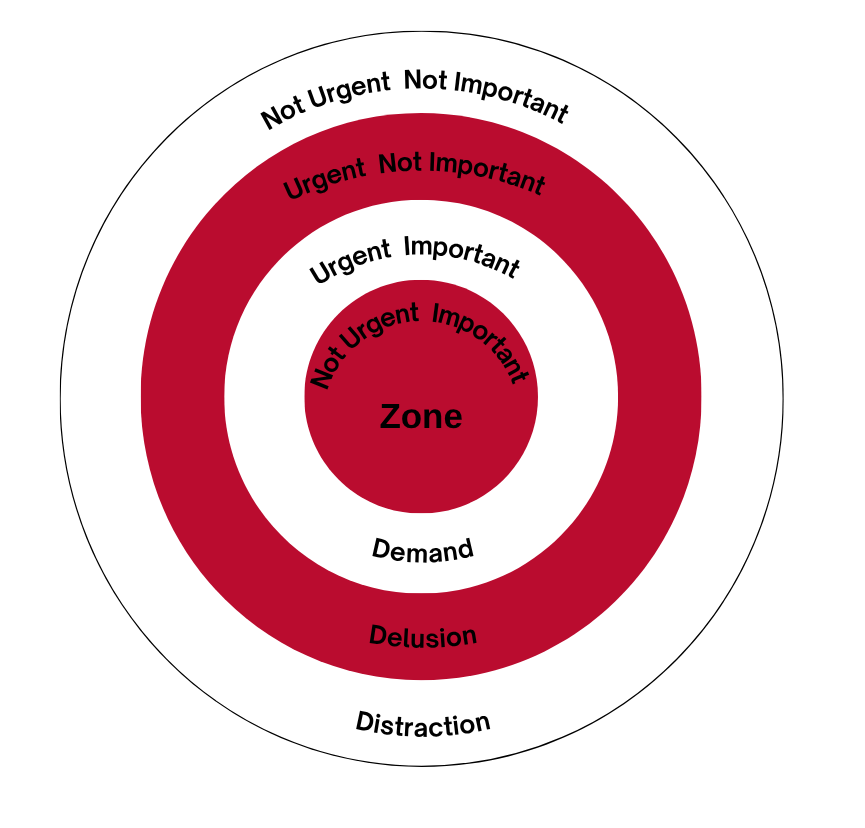
Distraction:
Most business owners are stuck in the outside layer that we call distraction. This is when we are focusing on tasks that are not urgent and not important.
Think of things like email, the random phone call that comes in, or the postman that stops in to chat for a while. These are all distractions in our day-to-day business.
Delusion:
The next step is delusion. This is where we think it’s urgent, but it’s really not important.
Oftentimes, this comes in the form of open-door policies with businesses. It’s been one of the biggest time efficiency killers that was ever created. It sounded like a good concept, but really when we have an open-door policy, what we’re saying is “let’s be distracted all day long and not be able to be focused.” So, there’s a delusion of when things are hitting us that they’re urgent, but in reality, they’re not as important as the things we as business owners should be working on.
Demand
The next layer is demand. These are the things that we think are urgent and we think are important. It might be things like taking a phone call from a client. That seems urgent and that seems important. However, we should have a team in place that can handle that. Or, we could have time slots to take those types of phone calls.
Zone
In general, most business owners stay down in distraction and delusion. These are the times when you get to the end of the day and you wonder why you were so busy but feel like you didn’t really accomplish anything. When you are saying that, then you are not “in the zone.”
The “zone” is where we are focusing on things that are not urgent, but they are important. This is when you’re working ON your business: the planning, the goal setting, the mentoring, building your team, and implementing the “six steps to a better business” that need to be in place. We want the majority of our time to eventually be “in the zone.” If the majority of the time can’t be “in the zone,” try to spend at least four to five hours a week there.
Remember: If you’re not working on your business, then who is?